Einordnung
This page is for everyone who plans maintenance — maintenance management, maintenance planning, plant management. The technology behind it is under Process AI, the way in under Free data check.
Your day
- Maintenance by the calendar
- The intervals are fixed, wear is not. Parts are replaced too early one time, too late the next.
- The stoppage plans with you
- An unplanned failure throws every plan out — staff, spare parts and restart included.
- The alarm comes too late
- Fixed limits react when a value breaks them. By then there is no time left to plan.
- Knowledge in a few heads
- How a problem builds up on which machine is known to one or two people — not to the plan.
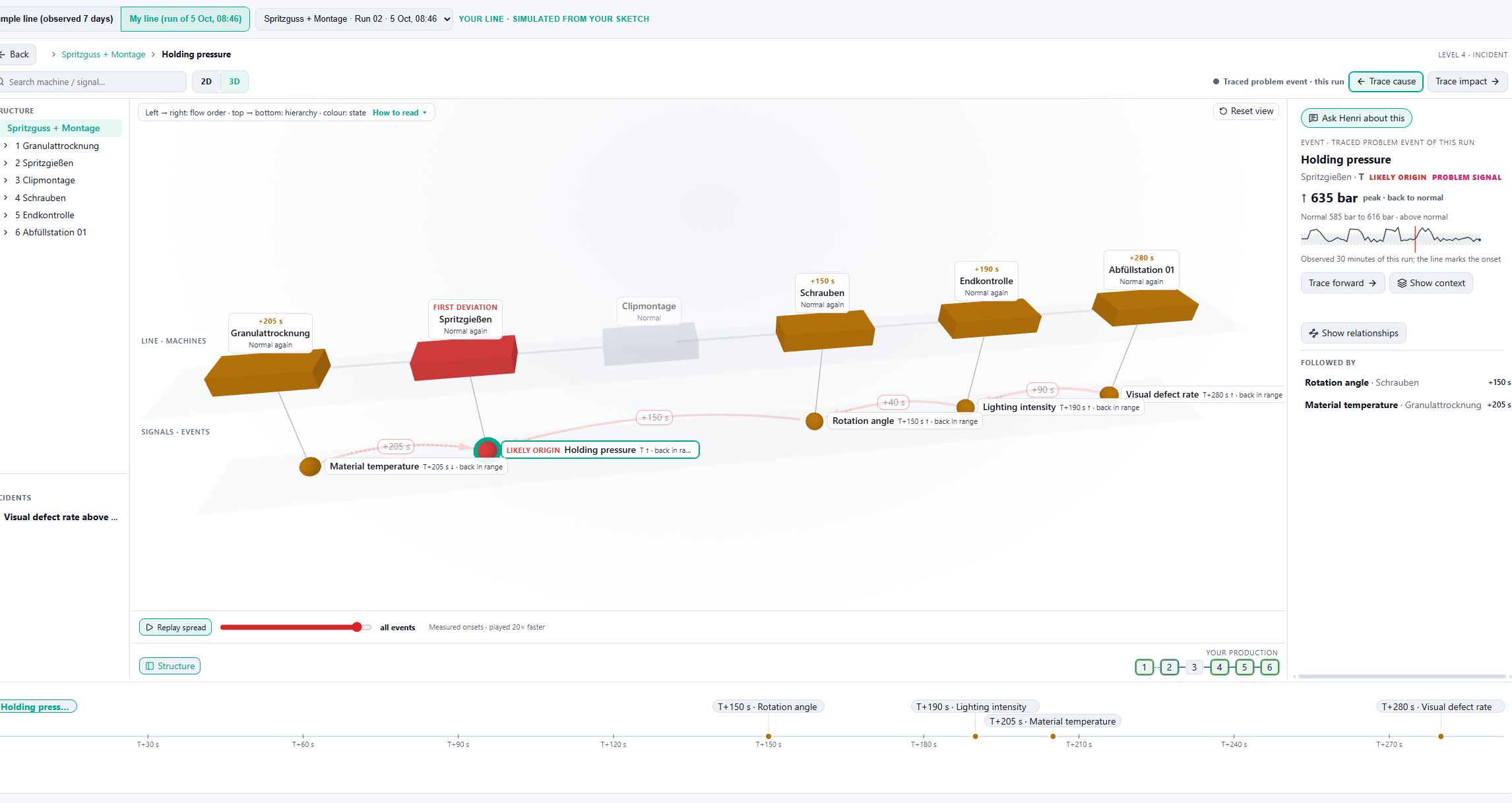
What SAIP gives your planning
- Time: The slow drift is named while values are still in the green range — not only when the fixed limit breaks.
- A finding instead of a light: Sensor, reading, expected value and direction — the basis for a work order.
- The decision stays with you: Whether and when to intervene is decided by your people. SAIP provides the trail, not the date.
- What stays: From findings you confirm, Henri builds knowledge of your plant locally — offline, in your own network.
The offer for this
Process AI
SAIP with Process AI — on-site at your controller.
- Read-only connection to your controller — no controller swap, no change to machine logic
- Explained alarms: sensor, reading, expected value and direction
- Runs on your hardware, air-gap capable, no cloud
- Way in: free data check, then a fixed-price pilot
What can be shown today
Slow driftExisting — detected against the learned normal range, not only fixed limits
Explained alarmsExisting — sensor, reading, expected value, direction
Start without training dataExisting — normal range from the first readings, useful from week one
OperationExisting — on your hardware, air-gap capable
What we do not promise
We do not predict which component will fail when, and we quote no remaining useful life. What SAIP does: name the deviation early so your planning has time. How much lead time that gives on your equipment is measured in the pilot — on your data.
How to start
With the free data check for the line that causes most of your unplanned stoppages. Then a fixed-price pilot — measured in your hours of downtime.